New Data show thousands of Ontario companies violating country’s toughest anti-harassment law
This article examines the addition of the new anti-harassment laws that make it mandatory for employers to investigate all harassment complaints. Specifically, this article focuses on the ways around this law that are taken in the food services and drinking places in Ontario. This law was enacted in 2016 and was entitled the Sexual Violence and Harassment Action Plan Act (Hancey, 2019). A report analyzed by the globe and mail stated that, “3,563 Ontario employers violated all harassment-related laws from September 2016, to January 2018” (Hancey, 2019). These employers were cited for 7,800 instances of failing to follow the law. The issue discussed in the article explains how the new law still allows big chains to offload responsibility for workplace harassment onto franchise owners (Hancey, 2019). The following figure represents the prevalence of workplace harassment cases in specific industries.
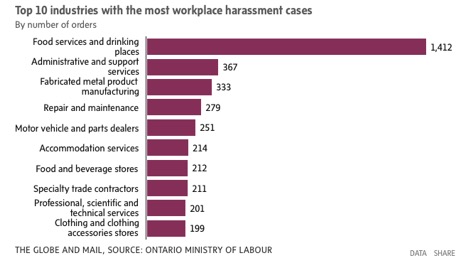
Because the law does not specify who is responsible, the franchise owner is the direct employer, meaning that the parent company is not legally responsible for responding to harassment complaints. This is an issue because the parent company keeps their good name and franchise owners takes the blame. The parent company, in this case, Tim Hortons place responsibility on the franchise owner but don’t provide the franchise owner with the proper training or knowledge of their roles and responsibilities (Hancey, 2019). This does not excuse franchise owners sexually harassing their employees, however providing them with proper training can teach them the consequences that follow their actions, or how to deal with reports when filed by employees. In addition to this, parent companies should teach the employees who work at their chains their rights as employees to be free of sexual harassment and to feel safe in their workplace (Ontario Human Rights Commission, 2013). This article examines a case at Second Cup in Ottawa, where an individual experienced sexual harassment from her former boss but did not report the sexual harassment because she was unaware that Ontario’s occupational health and safety laws contained specific harassment policies (Hancey, 2019).
This article also examines why it is the food industry specifically where this issue is prevalent – where experts suggest that it is because employees are prominently women and franchise owners are mostly men in the food industry. When reading this article, it becomes clear that this new law was a huge step forward – however it needs to be enforced and extended to parent companies and owners as a whole. Employees, women and men, have the right to be free from sexual and gender-based harassment (Ontario Human Rights Commission, 2013). Employees should be taught by their employers their rights in the workplace, and employers should be taught their roles and responsibilities especially when discussing the safety of their employees.
References
Hancey, Corbett. (2019, June 10). New Data show thousands of Ontario companies violating country’s toughest anti-harassment law. Retrieved February 28, 2020, from https://www.theglobeandmail.com/canada/article-new-data-show-thousands-of-ontario-companies-violating-countrys/
Ontario Human Rights Commission. (2013). Guide to your Rights and Responsibilities under the Human Rights Code. Retrieved February 28, 2020, from http://www.ohrc.on.ca/sites/default/files/Guide%20to%20Your%20Rights%20and%20Responsibilities%20Under%20the%20Code_2013.pdf
 Alaina Lewis' Blog
Hi Alaina,
I really enjoyed your blog post as it was an easy read and also very interesting! I was wondering if you believed that franchise owners being rather unknowledgeable about policies and procedures is something that should be the fault of the company or the franchise owner themselves? I too agree that with proper training of their roles and responsibilities it could fix a lot of legal issues that occur in workplaces be that; harassment issues, providing proper breaks, time off, overtime pay, etc.
Great work. Cheers!
LikeLike
Hello Ashleigh!
Thank you for your insightful comment and question! I believe that the company is at fault for the franchise owners being unknowledgeable. The parent company is responsible for the training standards of their employees. In the case of this article, the franchise owner obviously is not acting appropriately and their behaviour can not be excused. It is however important to notice that the parent companies did not comment on the standards that they outline for employees and franchise owners. Both parties are liable and demonstrating unacceptable behaviours towards lower level employees, and the company should make franchise owners aware of the consequences that come as a result of their actions, and make it known that behaviour of such manner is not tolerated within the company and employees who represent the company. I hope this answered your question!
Thanks!
Alaina Lewis
LikeLike
Hi Alaina,
I really enjoyed reading your post about the numerous violations of Canada’s toughest anti-harassment law. I thought some of the data and statistics you provided were shocking and demonstrates that laws on their own may not be followed in a variety of different settings. I found it interesting that the food services and drinking places industry was the highest in terms of workplace place harassment cases. I have personally worked in the food services industry and I agree with some of the reasons that you listed as to why this industry has experienced a significant amount of harassment cases. I thought your point about teaching employees their rights in the workplace will help with the problem. You mentioned some reasons why the food services and drinking places industry have high amounts of harassment cases, overall in any of the industries what are some other reasons why harassment occurs?
-Michael
LikeLike
Hello Michael!
This is a great question! There are many reasons that harassment occurs in all different industries. In every industry employees experience harassment, this can be for a multitude of reasons. I mentioned a lack of training, there is also cases of harassment in regards to an employees gender, race, sexuality, or any other defining characteristic. These are just some of the reasons harassment occurs within workplaces. I believe that providing employees knowledge about their rights in the workplace and informing employers about their roles and responsibilities would change the way that harassment in the workplace is current handled – with less incidents occurring and them being report and diligently handled when they do occur. I hope this answered your question!
Thank you,
Alaina Lewis
LikeLike